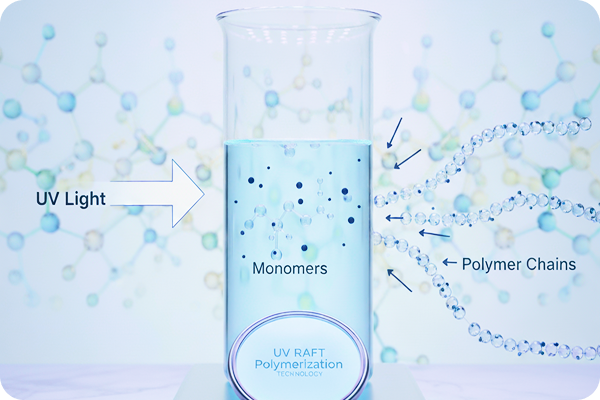
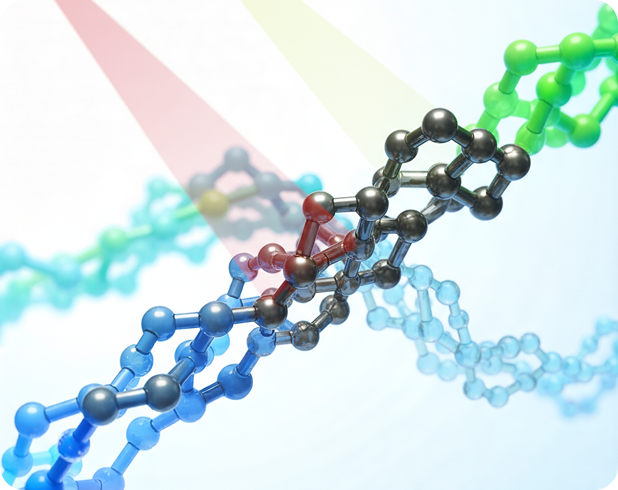
UV RAFT Polymerization, which stands for UV Reversible Addition Fragmentation Transfer, is a modern technology that utilizes light to control the precise formation of polymers.
Unlike traditional methods that rely on heat or uncontrolled free radical reactions, UV-Initiated RAFT uses light as a clean, tunable trigger.
This process enables the development of high-performance polymers that operate effectively in the most demanding applications through the control of polymer uniformity, architecture, molecular weight, charge, and other parameters.
In a typical UV-RAFT polymer reaction, UV light activates a chain transfer agent, which starts and controls the polymer formation. This approach gives better control over the size, shape, and structure of the polymer chains.
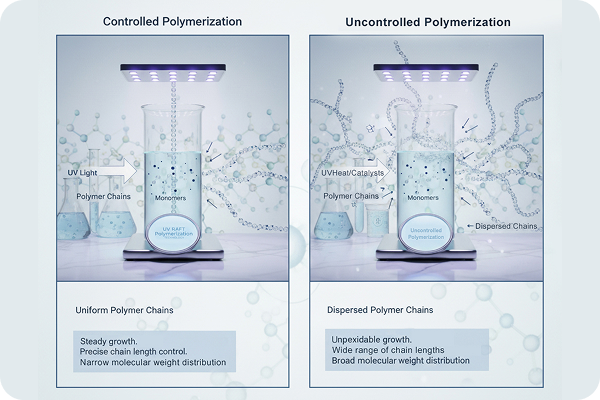
Compared to uncontrolled reactions, light-controlled polymerization ensures that the final product is more consistent, more predictable, and better suited to real-world applications.
Controlled vs. Uncontrolled Polymerization
Traditional polyacrylamide is synthesized through a random chain growth process. This can lead to poor performance, especially in harsh field conditions. UV RAFT technology, by contrast, enables batch-to-batch consistency and precise control over polymer architecture.
Benefits of controlled polymerization:
Tighter dispersity index
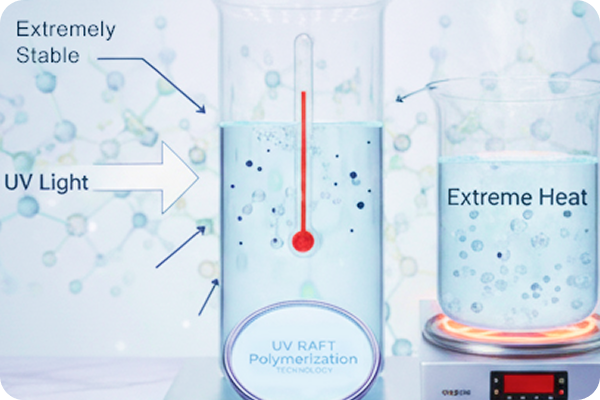
Lower risk of degradation under heat and salt
Consistent performance across different operating sites
Suited for Harsh Environments
Our UV RAFT technology delivers reliable performance where standard PAM begins to fail.
When applications demand stability, our polymers maintain structure and functionality, reducing dosage requirements and improving operational efficiency.
That’s why our technology is trusted in critical applications like:
Enhanced oil recovery (EOR)
Produced water treatment
Friction reduction in drilling operations
Wastewater treatment
Benefits of UV RAFT Technology
These benefits make UV RAFT a more intelligent choice for operators needing reliable results in challenging conditions:
Precision Control
Every polymer chain is built with uniformity using UV RAFT reaction control, which enhances both solubility and viscosity, allowing for better performance with reduced chemical input.
Scalable Technology
Our technology is a combination of UV technology and controlled polymerization reaction, making it energy-efficient, and safe to scale.
Refined Architecture
From star polymers and block copolymers to hydrogels and high-molecular-weight anionic PAM, our UV-triggered technology enables to build exactly what the process requires.
Light-Controlled Polymerization: From Concept to Chemistry
Each polymer fits the job.
Whether there’s a need for faster solubility, better dispersion, or stronger thermal resistance, our polymerization technology provides the flexibility to fine-tune the formulation:
Linear, star, and block polymers
Low, high, and ultra-high molecular weight PAM
Cationic and anionic grades
Thermo-responsive and pH-responsive hydrogels
Homopolymers and copolymers
Let’s Get in Touch
Ready to explore a more innovative, more consistent polymer solution?
UV RAFT is a light-triggered process that offers better control over polymer structure, improving performance in harsh field conditions. It reduces waste and allows custom builds that traditional methods can’t support.